Qurbani is one of the most important acts of worship during Eid ul Adha. Every year, millions of Muslims around the world perform this sacred Islamic sacrifice to honor the obedience of Prophet Ibrahim AS and follow the Sunnah of Prophet Muhammad ﷺ.
Yet many Muslims still feel confused about the exact Qurbani rules in Islam. Questions regularly arise:
- Who should give Qurbani?
- Is Qurbani wajib or sunnah?
- Can one cow be shared?
- What are the rules for husband and wife?
- What happens if the animal is too young?
- Can Qurbani be done online?
- How should Qurbani meat be distributed?
This complete Qurbani rules in Islam guide for Eid ul Adha 2026 explains every major Islamic ruling clearly and practically using Quran, authentic Hadith, and scholarly opinions from the Hanafi school and other madhahib.
Whether you are performing Qurbani for the first time or simply want to ensure your sacrifice is valid according to Islamic teachings, this guide will help you understand the rules properly.
What are the rules of Qurbani in Islam?
Qurbani is the Islamic sacrifice performed during Eid ul Adha after the Eid prayer between the 10th and 12th of Dhul Hijjah. Eligible Muslims who meet the Nisab threshold must sacrifice a healthy halal animal such as a goat, sheep, cow, or camel according to Islamic slaughter rules and distribute the meat among family, friends, and the poor.
Main Qurbani Rules in Islam
- Qurbani must be done after Eid prayer
- It is performed from 10th–12th Dhul Hijjah
- Animals must meet minimum age requirements
- Sick or defective animals are invalid
- One goat equals one share
- One cow or camel can have seven shares
- Slaughter must follow halal Islamic conditions
- Meat should ideally be divided into three parts
- Qurbani is wajib in the Hanafi school for eligible Muslims
| Animal | Minimum Age | Shares Allowed |
| Goat | 1 year | 1 |
| Sheep | 1 year (6 months if healthy and large) | 1 |
| Cow/Buffalo | 2 years | Up to 7 |
| Camel | 5 years | Up to 7 |
What is Qurbani in Islam?
Meaning of Qurbani and Udhiyah
Qurbani, also called Udhiyah, refers to the ritual sacrifice performed during Eid ul Adha in remembrance of Prophet Ibrahim AS.
The word “Qurbani” comes from the Arabic root “Qurb,” meaning closeness. The sacrifice symbolizes drawing closer to Allah through obedience, sincerity, and devotion.
The Story of Prophet Ibrahim AS
The foundation of Qurbani comes from the famous test of Prophet Ibrahim AS.
Allah commanded him in a dream to sacrifice his beloved son. Ibrahim AS submitted completely to Allah’s command, and his son willingly accepted the sacrifice.
Allah says in the Quran:
“Then when they had both submitted themselves, and he had laid him prostrate on his forehead, We called out to him: ‘O Ibrahim! You have fulfilled the vision.’”
(Surah As-Saffat 37:103–105)
Before the sacrifice took place, Allah replaced his son with a ram.
This event became a timeless symbol of obedience, sacrifice, and faith.
Spiritual Importance of Qurbani
Qurbani is not only about slaughtering an animal. It teaches:
- Submission to Allah
- Gratitude
- Compassion toward the poor
- Detachment from worldly attachment
- Reviving the Sunnah of Prophet Ibrahim AS
Allah says:
“Their meat will not reach Allah, nor will their blood, but what reaches Him is piety from you.”
(Surah Al-Hajj 22:37)
Connection to Eid ul Adha
Qurbani is performed during Eid ul Adha, one of the two major Islamic festivals.
It begins after the Eid prayer on the 10th of Dhul Hijjah and continues until sunset on the 12th according to most scholars.
Is Qurbani Obligatory or Sunnah?
Hanafi Opinion: Qurbani is Wajib
According to the Hanafi school, Qurbani is wajib upon every sane, adult Muslim who possesses wealth above the Nisab threshold.
The Hanafi scholars use the Hadith:
“Whoever can afford it but does not offer a sacrifice, let him not approach our place of prayer.”
(Ibn Majah)
This strong warning indicates obligation.
Opinion of Other Madhahib
The Maliki, Shafi’i, and Hanbali schools generally classify Qurbani as Sunnah Mu’akkadah (highly emphasized Sunnah).
This means:
- It is not sinful to leave intentionally
- But abandoning it regularly without reason is strongly disliked
Difference Between Wajib and Sunnah Mu’akkadah
| Term | Meaning |
| Wajib | Obligatory according to Hanafi scholars |
| Sunnah Mu’akkadah | Strongly emphasized Sunnah |
Practically, all scholars strongly encourage financially capable Muslims to perform Qurbani.
Scholarly Consensus on Importance
Despite differences in terminology, Islamic scholars agree:
- Qurbani is among the greatest acts of worship during Eid ul Adha
- It revives the Sunnah of Prophet Ibrahim AS
- Neglecting it carelessly contradicts the spirit of Eid
Who Must Give Qurbani?
Nisab Requirements
A Muslim must give Qurbani if they possess wealth above the Nisab threshold beyond basic needs.
This includes:
- Gold
- Silver
- Cash savings
- Business inventory
- Investments
The Nisab is similar to Zakat calculations.
Conditions for Qurbani Obligation
Qurbani becomes wajib in the Hanafi school if a person is:
- Muslim
- Adult
- Sane
- Resident (not a traveler)
- Owner of Nisab-level wealth
Men vs Women
Qurbani is not only for men.
If a woman independently owns Nisab wealth, Qurbani is also wajib upon her according to Hanafi scholars.
This is widely misunderstood.
Qurbani Rules for Husband and Wife in islam
A husband’s Qurbani does not automatically cover his wife.
If both spouses individually meet the Nisab requirement:
- Both should offer separate Qurbani
Example:
- Husband owns savings above Nisab → Qurbani wajib
- Wife owns gold jewelry above Nisab → Qurbani also wajib on her
Travelers
According to Hanafi scholars:
- Travelers are exempt from wajib Qurbani
- However, performing it remains rewarding
Poor Muslims
If a Muslim does not meet Nisab:
- Qurbani is not obligatory
- They can still participate voluntarily
Islam does not burden those without financial ability.
Children
Qurbani is not obligatory on children.
Parents may perform voluntary Qurbani on behalf of children if they wish.
Rules for Qurbani Animals
Permissible Animals
The following animals are valid for Qurbani:
- Goat
- Sheep
- Ram
- Cow
- Buffalo
- Camel
Birds or chickens are not valid for Eid sacrifice.
Qurbani Age of Animals
Animals must meet minimum age requirements.
| Animal | Minimum Age |
| Goat | 1 year |
| Sheep/Ram | 1 year |
| Sheep exception | 6 months if large and healthy |
| Cow/Buffalo | 2 years |
| Camel | 5 years |
Healthy Animal Conditions
The animal must be healthy and free from serious defects.
Valid animals should:
- Walk properly
- Have clear eyesight
- Be physically healthy
- Not be severely weak
Defects That Invalidate Qurbani
Qurbani becomes invalid if the animal is:
- Blind in one or both eyes
- Missing most teeth
- Extremely sick
- Severely lame
- Missing major body parts
- Extremely weak or dying
One Goat vs Shared Cow
| Animal | Number of Shares |
| Goat | 1 person |
| Sheep | 1 person |
| Cow | Up to 7 people |
| Camel | Up to 7 people |
Each share participant must intend Qurbani for worship purposes.
Camel Rules
Camels are valid and highly rewarded forms of sacrifice.
Conditions:
- Minimum age of five years
- Up to seven shares
- Must be healthy and slaughtered correctly
Time Rules for Qurbani
Exact Timing of Qurbani
Qurbani begins:
- After Eid prayer on the 10th of Dhul Hijjah
It ends:
- At sunset on the 12th of Dhul Hijjah
Why Sacrificing Before Eid Prayer is Invalid
Prophet Muhammad ﷺ said:
“Whoever slaughtered before the prayer, it is meat for his family and not sacrifice.”
(Bukhari)
This is a critical Qurbani rule many people misunderstand.
Best Time for Qurbani
The best time is:
- Immediately after Eid prayer on the 10th
This follows the Sunnah most closely.
Method of Halal Slaughter
Islamic Slaughter Conditions
The slaughter must fulfill Islamic requirements.
Conditions include:
- Animal must be alive
- Slaughter performed by a Muslim
- Allah’s name mentioned
- Sharp knife used
- Major veins cut properly
Takbeer During Slaughter
The Sunnah words include:
“Bismillahi Allahu Akbar”
Meaning:
“In the name of Allah, Allah is the Greatest.”
Knife Conditions
The knife should:
- Be extremely sharp
- Not be sharpened in front of the animal
- Minimize suffering
Animal Welfare in Islam
Islam strongly emphasizes mercy.
Prophet Muhammad ﷺ said:
“Allah has prescribed excellence in all things.”
(Muslim)
Cruel treatment directly contradicts Islamic teachings.
Qurbani Meat Distribution Rules
The 1/3 Distribution Rule
A recommended Sunnah method:
| Portion | Purpose |
| 1/3 | Family |
| 1/3 | Friends and relatives |
| 1/3 | Poor and needy |
Can All Meat Be Kept?
Yes. Scholars state it is permissible to keep all meat if necessary.
However:
- Sharing with the poor is highly encouraged
- Generosity is central to Eid ul Adha
Giving Meat to Non-Muslims
Many scholars permit gifting Qurbani meat to non-Muslim neighbors and friends.
This strengthens community relations and reflects Islamic kindness.
Selling Qurbani Meat
It is not permissible to:
- Sell Qurbani meat
- Sell hide/skin for personal profit
The butcher should not be paid using meat as wages.
Can You Give Qurbani Online?
Is Online Qurbani Valid?
Yes, online Qurbani is valid if:
- The organization follows Islamic slaughter rules
- Sacrifice occurs within proper time
- Correct intention is made
Charity Qurbani
Many Muslims now perform Qurbani through Islamic charities to help poorer communities worldwide.
Benefits include:
- Feeding vulnerable families
- Lower cost in some countries
- Wider social impact
Common Mistakes With Online Qurbani
People often:
- Choose unverified organizations
- Ignore slaughter standards
- Assume all charities follow Sharia correctly
Choosing Trusted Organizations
Check:
- Transparency
- Islamic scholar supervision
- Clear slaughter procedures
- Distribution reports
- Reputation
Common Mistakes Muslims Make
1. Wrong Animal Age
Many sacrifices become invalid because animals are underage.
Always verify age carefully.
2. Sacrificing Before Eid Prayer
This invalidates Qurbani completely.
3. Misunderstanding Wajib Ruling
Some financially capable Muslims ignore Qurbani thinking it is optional.
4. Poor Meat Distribution
Keeping everything while ignoring needy families opposes the spirit of sacrifice.
5. Ignoring Animal Welfare
Cruel handling, overcrowding, and careless slaughter violate Islamic ethics.
6. Treating Qurbani as Culture Only
Qurbani is worship — not merely tradition or celebration.
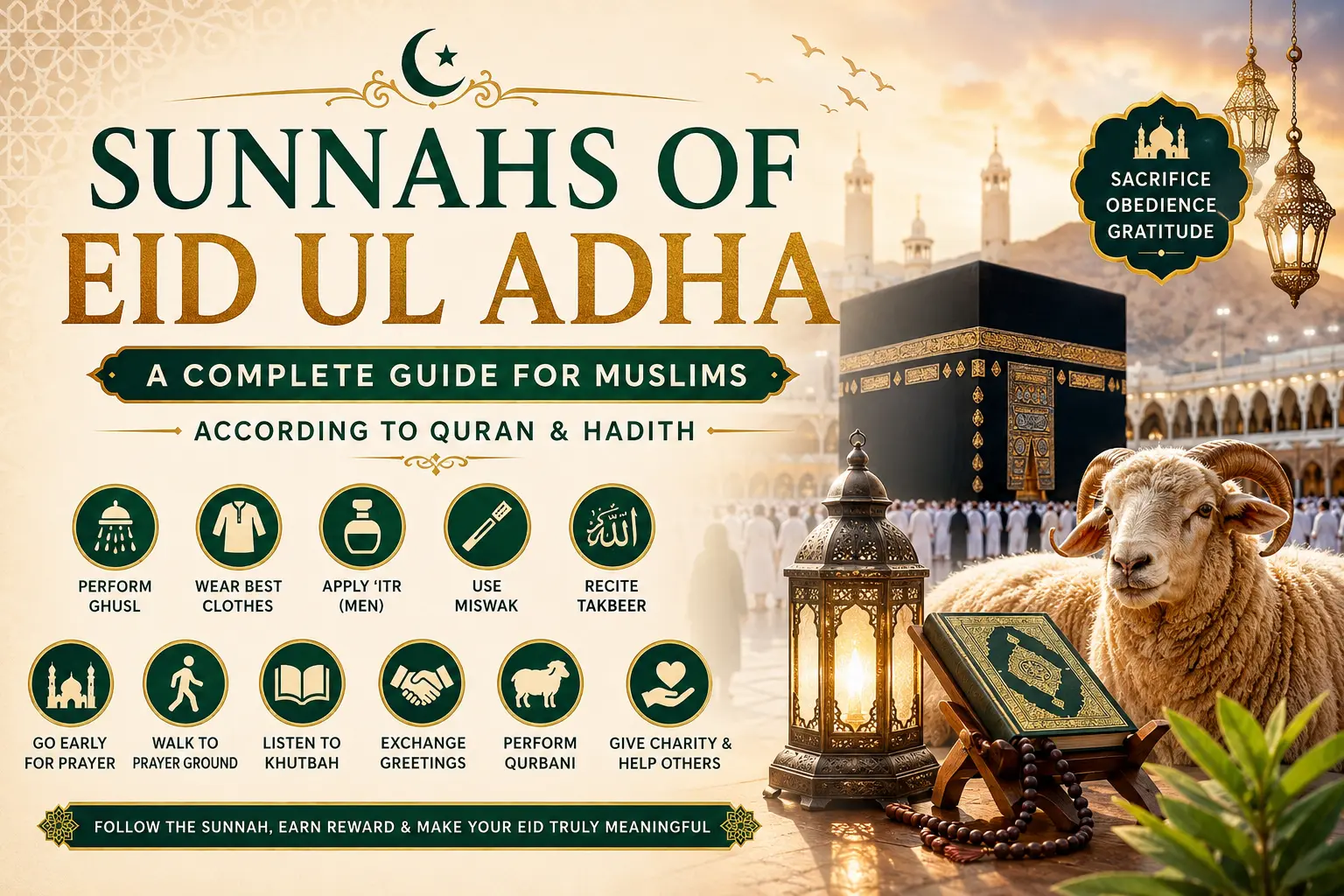
Sunnahs of Eid ul Adha Related to Qurbani
1. Saying Takbeer
Recite Takbeer frequently during the days of Dhul Hijjah.
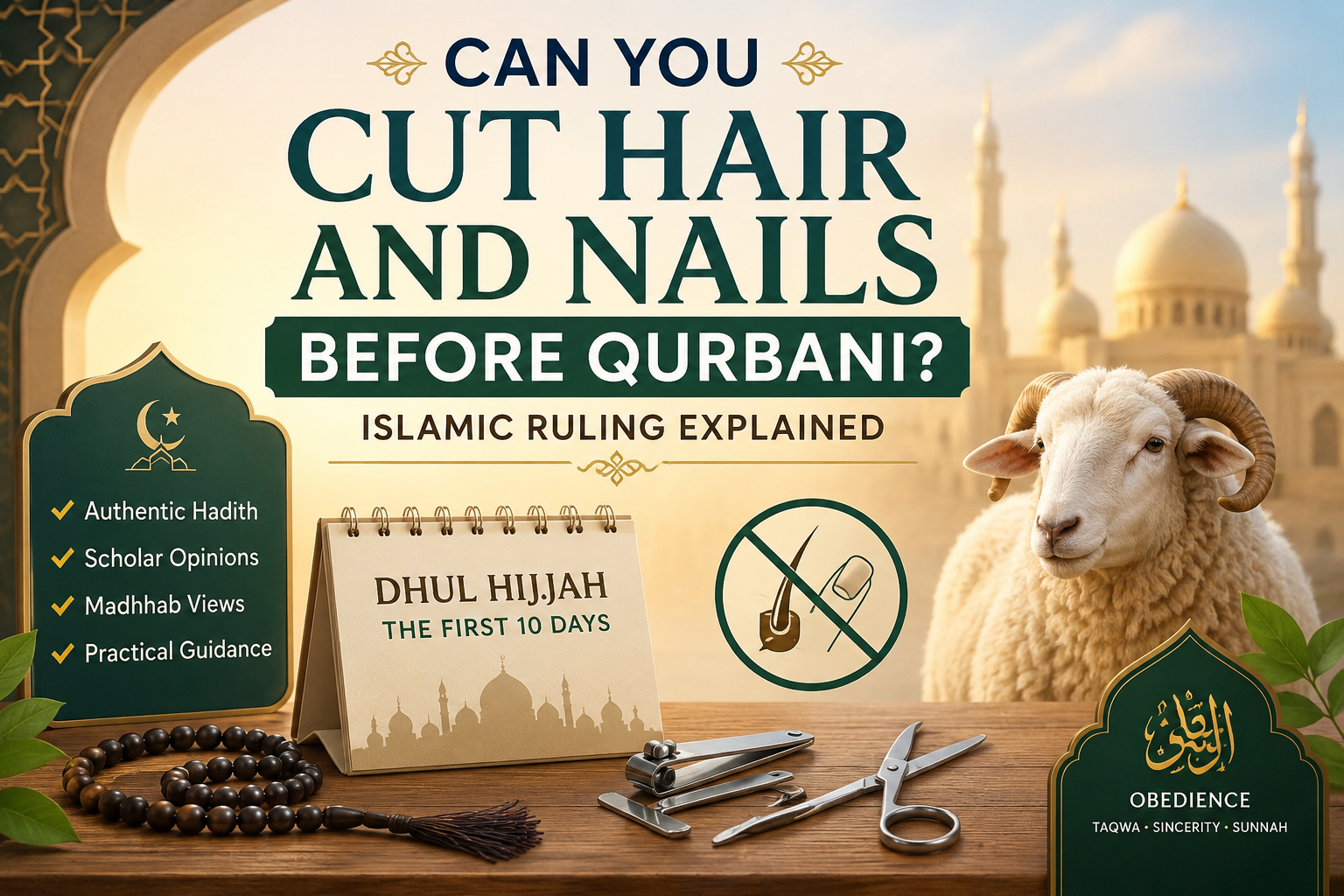
2. Avoid Cutting Hair and Nails
Prophet Muhammad ﷺ instructed those intending Qurbani:
- Avoid cutting hair and nails after Dhul Hijjah begins until sacrifice is complete
3. Attending Eid Prayer
The Eid prayer is among the strongest Sunnahs of Eid ul Adha.
4. Eating After Sacrifice
It is Sunnah to eat from one’s own Qurbani meat after sacrifice.
5. Performing the Sacrifice Personally
If possible, it is recommended to witness or perform the slaughter personally.
Step-by-Step Qurbani Checklist
Before Eid ul Adha
Financial Preparation
- Check Nisab eligibility
- Budget for sacrifice
- Choose valid animal
Spiritual Preparation
- Renew intention
- Increase Takbeer
- Avoid cutting hair/nails
Choosing the Animal
- Verify minimum age
- Ensure animal is healthy
- Avoid defective animals
- Confirm share arrangement if using cow/camel
During Slaughter
- Perform after Eid prayer
- Say “Bismillahi Allahu Akbar”
- Use sharp knife
- Treat animal gently
After Slaughter
- Divide meat properly
- Share with needy families
- Store meat hygienically
- Thank Allah sincerely
Practical Examples of Qurbani Rulings
Example 1: Husband and Wife
A husband earns income and owns savings above Nisab. His wife owns gold jewelry above Nisab.
Ruling:
- Both should perform separate Qurbani according to Hanafi scholars.
Example 2: Student Living Abroad
A university student owns little money and does not meet Nisab.
Ruling:
- Qurbani is not wajib.
Example 3: Shared Cow
Seven friends jointly purchase one cow.
Ruling:
- Valid if each intends worship and sacrifice.
People Also Ask
Is Qurbani Farz?
No. According to Hanafi scholars it is wajib, while other schools consider it Sunnah Mu’akkadah.
Can One Qurbani Cover the Whole Family?
One goat generally counts for one individual obligation. However, reward may be shared with family members.
Can Qurbani Be Done in Another Country?
Yes. Many Muslims delegate Qurbani internationally through trusted charities.
What Happens if Qurbani is Missed?
According to Hanafi scholars:
- Repentance is necessary
- Equivalent charity may need to be given
What are the rules of Qurbani in Islam?
Qurbani must be performed after Eid prayer during 10th–12th Dhul Hijjah using a healthy halal animal that meets Islamic age and slaughter conditions.
Is Qurbani compulsory for husband and wife?
If both independently meet Nisab requirements, both should perform separate Qurbani according to Hanafi scholars.
What animals are allowed for Qurbani?
Goats, sheep, cows, buffalo, and camels are valid Qurbani animals.
Can Qurbani be done in another country?
Yes. Delegating Qurbani to trusted charities overseas is permissible.
How is Qurbani meat distributed?
The Sunnah recommendation is:
- 1/3 for family
- 1/3 for relatives/friends
- 1/3 for poor people
What invalidates Qurbani?
Common invalidators include:
- Sacrificing before Eid prayer
- Underage animals
- Major defects
- Improper slaughter
Can one cow be shared for Qurbani?
Yes. One cow or camel can be shared by up to seven people.
What is the age requirement for Qurbani animals?
- Goat/sheep: 1 year
- Cow: 2 years
- Camel: 5 years
Is online Qurbani valid in Islam?
Yes, if proper Islamic procedures are followed.
What happens if Qurbani is missed?
According to Hanafi scholars, repentance should be made and compensation may be required.
Conclusion
Understanding Qurbani rules in Islam properly is essential for every Muslim preparing for Eid ul Adha 2026. This sacred act of Islamic sacrifice is not merely tradition — it is worship rooted in sincerity, obedience, generosity, and devotion to Allah.
The core principles of Qurbani in Islam remain clear:
- Fulfill the correct Islamic conditions
- Choose valid animals
- Observe proper timing
- Follow halal slaughter rules
- Care for the poor through meat distribution
- Revive the Sunnah of Prophet Ibrahim AS and Prophet Muhammad ﷺ
When performed correctly, Qurbani becomes far more than slaughter. It becomes a powerful reminder that true faith requires sacrifice, submission, and compassion.
If you are financially able, prepare early for Eid ul Adha 2026 and ensure your Qurbani fulfills all Islamic requirements properly