Every year, as Dhul Hijjah approaches, the same question surfaces in Muslim households around the world: Can I cut hair and nails before Qurbani? Some people hear it’s strictly forbidden. Others think it’s just a recommendation. A few have never heard about it at all.
The confusion is understandable. This ruling sits at an interesting intersection of scholarly difference, varying levels of religious obligation, and the practical realities of daily life. Getting it wrong in either direction — either ignoring it entirely or treating it as more severe than it is — can lead to unnecessary guilt or a missed spiritual opportunity.
This guide breaks it all down: the authentic hadith, what the four major schools of Islamic jurisprudence say, the practical ruling for everyday Muslims, and answers to the most common questions people ask.
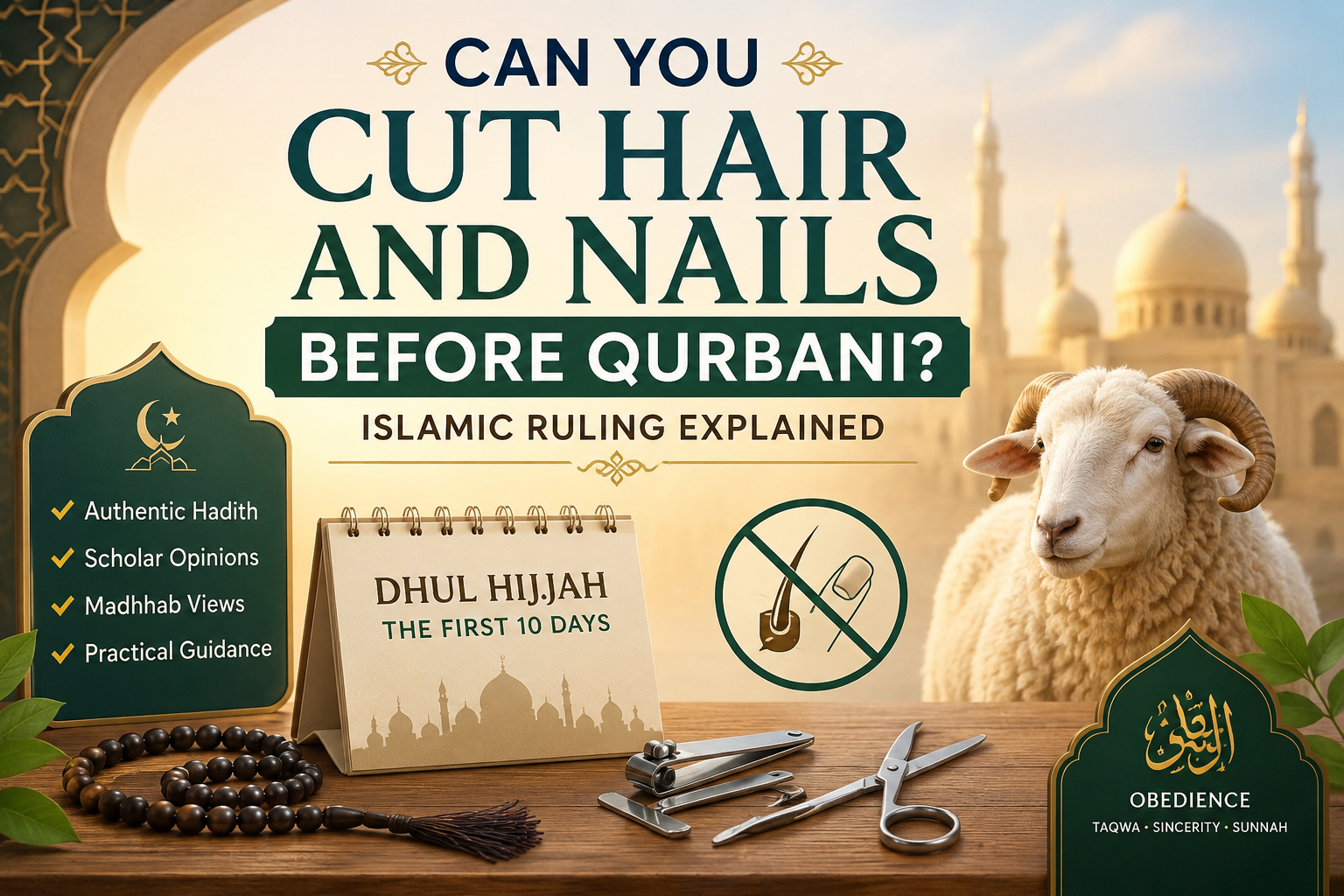
Can you cut hair and nails before Qurbani?
If you intend to offer Qurbani (Udhiyah), it is strongly recommended — and according to most scholars, obligatory to avoid — cutting your hair or nails from the 1st of Dhul Hijjah until after your Qurbani is slaughtered. This is based on an authentic hadith from Sahih Muslim. The majority scholarly view holds that cutting hair or nails during this period is prohibited (haram) for the one offering the sacrifice, while others consider it disliked (makruh). It is not a condition of Qurbani’s validity — if you cut accidentally or out of forgetfulness, your Qurbani remains accepted.
The Islamic Ruling on Cutting Hair and Nails Before Qurbani
What Exactly Does the Ruling Apply To?
The ruling applies specifically to the person who intends to offer the Qurbani sacrifice — known in Arabic as the Udhiyah or Dahiya. It covers:
- Hair on any part of the body (head, beard, body hair, pubic hair, underarm hair)
- Nails on both the hands and feet
The restriction begins at the start of the month of Dhul Hijjah — the twelfth and final month of the Islamic lunar calendar — and ends once the person’s Qurbani animal has been slaughtered.
It does not apply to members of the household who are not personally offering the sacrifice, though some scholars recommend they also follow this practice out of reverence for the occasion.
Understanding the Issue Properly
Before discussing rulings, one important point must be clear:
This matter only applies to the person offering the Qurbani.
It does not automatically apply to:
- the entire household
- children
- spouses
- family members on whose behalf the sacrifice is shared
For example, if a father is paying for the Qurbani, the ruling mainly concerns him, not necessarily every member of the house.
This misunderstanding alone causes unnecessary hardship for many families every year.
The Hadith Evidence: What the Prophet ﷺ Actually Said
This ruling is not a matter of opinion or cultural tradition. It comes directly from an authentic hadith recorded in Sahih Muslim — one of the two most rigorously authenticated hadith collections in Islam.
The Primary Hadith
Umm Salamah (may Allah be pleased with her) reported that the Prophet Muhammad ﷺ said:
“When you see the new moon of Dhul Hijjah and one of you wishes to offer a sacrifice, he should not cut his hair or nails until he has offered his sacrifice.” — Sahih Muslim (1977)
This narration is clear, direct, and unambiguous. The Prophet ﷺ tied the act of refraining from cutting hair and nails to the intention to offer sacrifice. The moment someone decides they will perform Qurbani, this ruling comes into effect from the 1st of Dhul Hijjah.
A Second Narration (Sunan Abu Dawud)
In another narration, Umm Salamah (may Allah be pleased with her) quotes the Prophet ﷺ:
“Whoever has an animal to sacrifice, when the month of Dhul Hijjah has begun, should not cut his hair or trim his nails.” — Sunan Abu Dawud (2791), graded authentic
Both narrations converge on the same ruling: refrain from cutting hair and nails once Dhul Hijjah begins, if you plan to offer Qurbani.
What Scholars Say: Understanding the Scholarly Debate
Islamic jurisprudence is rich with nuance, and this issue is no exception. Scholars across history have approached this hadith carefully, weighing its implications.
Is It Haram, Makruh, or Just a Recommendation?
This is where the real scholarly difference (ikhtilaf) lies. There are three major positions:
Position 1 — Prohibited (Haram):
The majority of scholars, including the Hanbali school and many Shafi’i scholars, hold that cutting hair and nails during the first ten days of Dhul Hijjah is haram for the person intending Qurbani. They point to the unqualified prohibitive wording of the hadith, treating the Prophet’s ﷺ command as a direct prohibition.
Position 2 — Disliked (Makruh Tanzihan)
The Hanafi school generally considers cutting hair and nails during this period to be makruh — disliked and discouraged, but not sinful. Their reasoning centers on the interpretation that the hadith contains an implied dislike, not an absolute prohibition.
Position 3 — Recommended to Avoid (Sunnah)
Some later scholars interpreted this as a recommended act of following the Prophet’s ﷺ guidance, falling short of outright prohibition. This is a minority position.
The strongest and most cautious position, and the one held by most hadith scholars, is that it is prohibited (haram) to cut hair or nails once Dhul Hijjah begins if one intends to offer Qurbani. Acting on the direct wording of an authenticated hadith is always the safer course.
The Four Madhhab Opinions Explained
Hanbali View
Imam Ahmad ibn Hanbal held this ruling to be a clear prohibition. The Hanbali school is arguably the most explicit in treating the cutting of hair and nails as haram during these ten days for those offering sacrifice. Some Hanbali scholars extend this to consider the entire act of cutting — even a single hair — as sinful, though the Qurbani itself remains valid.
Shafi’i View
The Shafi’i school considers it haram to cut hair or nails during this period, aligning closely with the Hanbali position on the prohibition. Imam al-Nawawi, one of the greatest Shafi’i scholars, affirmed this ruling in his explanation of Sahih Muslim, reinforcing that the hadith establishes a genuine prohibition, not merely a recommendation.
Maliki View
The Maliki school holds that it is makruh (disliked) rather than outright haram. They give significant weight to a competing narration attributed to ‘A’ishah (may Allah be pleased with her) in which she described plaiting the garlands of the Prophet’s ﷺ sacrificial animals without him entering into a state resembling ihram. Maliki scholars use this to soften the prohibition, arguing the person offering Qurbani is not in the same category as someone in ihram.
Hanafi View
The Hanafi school, predominant in South Asia, Turkey, and Central Asia, considers the act makruh tanzihan — disliked in a non-binding way. While they do not classify it as sinful, they still encourage Muslims to follow this practice out of respect for the prophetic tradition. Many Hanafi scholars note that the wisdom of the ruling is to emulate those in ihram, creating a spiritual parallel between the person offering sacrifice and the pilgrims in Makkah.The Wisdom Behind This Ruling
One of the beautiful things about Islamic law is that most rulings carry a discernible wisdom. The scholars have offered several explanations for why this practice is recommended or required:
1. Resemblance to the Pilgrim in Ihram The person offering Qurbani, even from afar, shares in the spirit of Hajj. By refraining from cutting hair and nails — something the pilgrim in ihram cannot do — they create a symbolic connection with the pilgrims circling the Ka’bah in Makkah.
2. Presenting the Full Self Before Allah Some scholars suggest that refraining from cutting signifies presenting one’s complete self — in totality — as an act of devotion to Allah in these blessed days.
3. Maximizing Reward Through Restraint The first ten days of Dhul Hijjah are the most virtuous days of the year, according to multiple authentic hadith. Voluntary restraint in these days is a form of worship, mirroring the spirit of increased devotion during Ramadan.
Common Misunderstandings About This Ruling
Misunderstanding 1: “This ruling is like ihram — it makes Qurbani invalid if broken.”
Incorrect. If you cut your hair or nails during this period — whether intentionally or by forgetting — your Qurbani remains completely valid. This is not a condition (shart) of the sacrifice. The person who cuts has done something disliked or prohibited, but the Qurbani itself is accepted.
Misunderstanding 2: “The whole family must avoid cutting hair and nails.”
Not necessarily. The ruling applies to the person who is offering the sacrifice. Family members who are not themselves the sahib al-qurbani (owner of the sacrifice) are not bound by this ruling, though they may choose to follow it voluntarily.
Misunderstanding 3: “Can you trim the beard before Qurbani? That’s different.”
It is not different. The beard is hair, and the ruling applies equally. Trimming, shaping, or shaving the beard falls under the same prohibition for the one intending Qurbani during the first ten days of Dhul Hijjah.
Misunderstanding 4: “If someone else is paying for my Qurbani, I don’t need to follow this.”
This depends on intention and arrangement. If you are the designated person offering the sacrifice on behalf of your household — the one in whose name the Qurbani is made — then the ruling applies to you. If you have specifically nominated someone else as the sahib al-udhiyah, the ruling applies to that person.
Misunderstanding 5: “You can cut nails for cleanliness before Qurbani day.”
This is not an exception recognized by most scholars. Necessity (darura) could apply in extreme medical situations, but routine cleanliness is not considered a valid excuse to override this prophetic guidance. Plan your nail trimming before Dhul Hijjah begins.
Practical Guidance for Muslims
Here is a clear, practical approach to follow:
Before Dhul Hijjah Begins: Trim your hair, cut your nails, and take care of any grooming you need. This is the smartest approach — remove any need for grooming before the month even starts.
Once Dhul Hijjah Begins (If You Intend Qurbani)
Refrain from cutting hair (including beard, mustache, body hair) and nails until your Qurbani is completed. This period lasts a maximum of ten days.
If You Cut by Mistake
Your Qurbani is still valid. Seek forgiveness, and be more careful for the remaining days. There is no expiation (kaffarah) required — this is not like breaking a fast deliberately.
When Someone Else Is Doing Your Qurbani
If your Qurbani is being arranged through an Islamic charity or organization and they slaughter on your behalf in another country, wait until you receive confirmation that the slaughter has been completed before trimming.
When You Forgot You Were Getting Qurbani Done
If you were not originally planning Qurbani and someone added you or gifted you one, begin following this ruling from the moment you become aware of it.
FAQs: People Also Ask
Can I cut my hair before Qurbani if I really need to?
According to the majority of scholars, no — it is prohibited for the person offering Qurbani to cut their hair from the 1st of Dhul Hijjah until after the sacrifice. Routine need does not constitute a valid exception. Plan your haircut before Dhul Hijjah begins.
What if I accidentally cut my nails before Qurbani?
Your Qurbani remains valid. The prohibition does not invalidate the sacrifice — it only means the person has done something they should have avoided. Seek forgiveness and be careful for the remaining time.
Does this ruling apply to women?
Yes. If a woman is the one offering the Qurbani, the same ruling applies to her. If her husband is offering the sacrifice, she is not personally bound by this ruling, though she may follow it voluntarily.
Can you trim the beard before Qurbani?
No. The beard is hair, and trimming it falls under the same ruling as cutting head hair. Refraining from trimming the beard is part of the practice for someone intending Qurbani during Dhul Hijjah.
What is the cutting nails ruling in Dhul Hijjah according to different scholars?
The Hanbali and Shafi’i schools consider it haram (prohibited). The Hanafi and Maliki schools consider it makruh (disliked). All four schools agree it should be avoided; they differ only on the degree of prohibition.
Does the Qurbani ruling on hair and nails apply to those performing Hajj?
Pilgrims in ihram are separately prohibited from cutting hair and nails as part of their ihram rules. The ruling discussed here applies specifically to Muslims not performing Hajj who are offering Qurbani from their home countries.
When can I cut my hair after Qurbani?
You may cut your hair and nails immediately after your Qurbani animal has been slaughtered. There is no need to wait until Eid prayer or any other event.
Is the ruling about hair and nails in Dhul Hijjah mentioned in the Quran?
No, this specific ruling comes from hadith, not directly from the Quran. It is found in Sahih Muslim and Sunan Abu Dawud, both considered among the most authentic hadith collections.
What if my Qurbani is being done overseas by a charity — when does the restriction end?
The restriction ends when the slaughter is completed, even if it occurs in another country. Many scholars recommend waiting until the time of Eid prayer on the 10th of Dhul Hijjah as a safe estimate if you are unsure of the exact time of slaughter.
Is it haram or just sunnah to avoid cutting hair before Eid ul Adha?
According to the Hanbali and Shafi’i schools, it is haram for the one offering Qurbani. According to the Hanafi and Maliki schools, it is makruh (disliked). It is not merely a voluntary sunnah — there is a stronger obligation attached to it based on the direct hadith of the Prophet ﷺ.
Conclusion
The ruling to cut hair and nails before Qurbani is one of those Islamic practices that is rooted in clear prophetic guidance yet surrounded by genuine scholarly nuance. The hadith in Sahih Muslim is authentic and unambiguous in its instruction: if you intend to offer Qurbani, hold off on cutting your hair or nails from the beginning of Dhul Hijjah until your sacrifice is done.
The safest and most sound position — held by the majority of hadith scholars, the Hanbali school, and leading Shafi’i scholars — is that this is a prohibition, not merely a recommendation. Even those who classify it as makruh (Hanafi and Maliki schools) agree that it should be avoided. On this, there is no real disagreement.
More importantly, this practice is a beautiful spiritual opportunity. For just ten days, the one offering Qurbani can walk in symbolic solidarity with the pilgrims of Makkah, presenting themselves — uncut, complete — before Allah in the holiest days of the Islamic year.
Prepare early. Trim before Dhul Hijjah. And embrace these ten days as the gift they truly are.