Millions of Muslims travel to Saudi Arabia every year to perform either Hajj or Umrah. However, many people — especially beginners — get confused about the difference between the two. Some think they are the same act of worship, while others assume Umrah can replace Hajj.
The truth is simple: both are sacred pilgrimages in Islam, but they are very different in terms of obligation, timing, rituals, and rewards.
In this complete guide, you will learn:
- What Hajj is
- What Umrah is
- The main differences between Hajj and Umrah
- Which one is compulsory
- Rituals involved in each
- Costs and duration
- Spiritual rewards
- Common misconceptions
Whether you are planning your first pilgrimage or simply trying to understand Islamic teachings better, this guide explains everything in simple English.
What is Hajj?
Hajj is the major Islamic pilgrimage to Makkah and one of the Five Pillars of Islam. Every Muslim who is physically and financially able must perform Hajj at least once in their lifetime.
Hajj takes place only during specific dates in the Islamic month of Dhul Hijjah.
Allah says in the Quran:
“And pilgrimage to the House is a duty owed to Allah by all who can make their way to it.”
— Surah Aal-e-Imran (3:97)
Hajj is not just a journey. It is a complete act of worship that teaches:
- sacrifice
- patience
- humility
- obedience to Allah
- equality among Muslims
During Hajj, millions of Muslims wear simple white clothing called Ihram, showing that all people are equal before Allah.
What is Umrah?
Umrah is known as the “lesser pilgrimage.” It is a voluntary act of worship that Muslims can perform at any time of the year.
Although Umrah is highly rewarding, it is not one of the Five Pillars of Islam.
Umrah includes fewer rituals compared to Hajj and usually takes only a few hours to complete.
Many Muslims perform Umrah during:
- Ramadan
- school holidays
- before or after Hajj season
- spiritually important times
The Prophet Muhammad ﷺ encouraged Muslims to perform Umrah because it removes sins and strengthens faith.
A famous Hadith says:
“One Umrah to another Umrah is an expiation for the sins committed between them.”
— Sahih al-Bukhari
Main Difference Between Hajj and Umrah
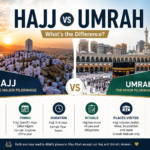
The biggest difference is that Hajj is obligatory while Umrah is optional.
Here is the simple explanation:
| Feature | Hajj | Umrah |
| Obligation | Compulsory once in lifetime | Voluntary |
| Pillar of Islam | Yes | No |
| Specific Dates | Only Dhul Hijjah | Anytime |
| Duration | Several days | Few hours |
| Rituals | More detailed | Simpler |
| Arafah Required | Yes | No |
| Mina & Muzdalifah | Yes | No |
| Animal Sacrifice | Often required | Usually not |
This table alone answers most beginner questions.
Is Hajj Compulsory?
Yes. Hajj is compulsory for every Muslim who:
- is an adult
- is mentally sound
- is physically capable
- can financially afford the journey
This obligation applies once in a lifetime.
If a Muslim has the ability to perform Hajj but delays it without a valid reason, many scholars consider this sinful.
However, Islam does not burden people beyond their capability. If someone cannot afford Hajj or has serious health issues, they are excused.
Is Umrah Compulsory?
Scholars differ on this issue.
- The Hanafi and Maliki schools generally consider Umrah a Sunnah Mu’akkadah (highly recommended).
- The Shafi’i and Hanbali schools often consider it obligatory once in a lifetime.
Regardless of scholarly differences, Umrah is extremely virtuous and spiritually beneficial.
Rituals of Hajj Explained
Hajj includes several major rituals performed over multiple days.
1. Entering Ihram
Pilgrims enter a sacred spiritual state called Ihram.
Men wear two white cloths.
Women wear modest Islamic clothing.
Pilgrims make intention and recite the Talbiyah:
“Labbayk Allahumma Labbayk…”
2. Tawaf
Pilgrims circle the Kaaba seven times.
This act symbolizes devotion and unity around the worship of Allah.
3. Sa’i
Pilgrims walk between Safa and Marwah seven times.
This honors the struggle of Hajar (AS), the wife of Prophet Ibrahim (AS).
4. Mina
Pilgrims travel to Mina and spend the day in worship.
This is the most important part of Hajj.
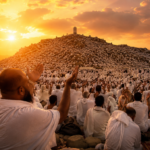
Pilgrims stand in prayer and supplication at Mount Arafat.
The Prophet Muhammad ﷺ said:
“Hajj is Arafah.”
Missing Arafah invalidates Hajj.
6. Muzdalifah
Pilgrims collect pebbles and spend the night in worship.
7. Rami (Stoning the Jamarat)
Pilgrims throw pebbles at symbolic pillars representing Shaytan.
This symbolizes rejecting temptation and evil.
8. Qurbani (Sacrifice)
Many pilgrims offer an animal sacrifice.
This commemorates the obedience of Prophet Ibrahim (AS).
9. Final Tawaf
Pilgrims perform a farewell Tawaf before leaving Makkah.
Rituals of Umrah Explained
Umrah is much shorter and simpler.
It includes four main steps.
1. Ihram
Pilgrims enter the state of Ihram.
2. Tawaf
Walk around the Kaaba seven times.
3. Sa’i
Walk between Safa and Marwah seven times.
4. Halq or Taqsir
Men shave or trim their hair.
Women trim a small portion.
After this, Umrah is complete.
Time Difference Between Hajj and Umrah
Hajj can only be performed during specific days:
- 8th to 13th Dhul Hijjah
If someone goes to Makkah outside these dates, they cannot perform Hajj.
Umrah, however, can be performed throughout the year.
This flexibility makes Umrah easier for many Muslims.
Duration of Hajj vs Umrah
Hajj usually takes 5 to 6 days officially, though travel packages may last longer.
Umrah can often be completed within:
- a few hours
- one day
- a short trip
This is one reason millions more people perform Umrah annually.
Rewards of Hajj and Umrah
Both pilgrimages carry enormous spiritual rewards.
Reward of Hajj
The Prophet Muhammad ﷺ said:
“Whoever performs Hajj and does not commit sin will return as pure as the day they were born.”
— Sahih al-Bukhari
Accepted Hajj can erase sins completely.
Reward of Umrah
Umrah also removes sins and strengthens faith.
The Prophet ﷺ said:
“One Umrah to another is expiation for the sins between them.”
Umrah during Ramadan has especially great reward.
Cost Difference Between Hajj and Umrah
Hajj is usually much more expensive because:
- it lasts longer
- travel demand is high
- accommodation costs increase
- transportation between holy sites is required
Umrah is generally cheaper and more flexible.
Many Muslims save for years to perform Hajj.
Can Umrah Replace Hajj?
No.
This is one of the biggest misconceptions.
Even if someone performs Umrah many times, it does not remove the obligation of Hajj.
If a Muslim becomes financially and physically capable, Hajj remains obligatory.
Which is More Important?
Hajj is more important because:
- it is a pillar of Islam
- it is compulsory
- it includes greater rituals and obligations
However, Umrah still has tremendous rewards and spiritual benefits.
For many Muslims, Umrah becomes a life-changing experience that strengthens their connection with Allah.
Common Misconceptions
“Umrah and Hajj are the same”
False.
Hajj includes additional rituals and specific timing.
“Women do not need permission for Hajj”
Islamic rulings vary depending on safety, guardianship, and local regulations.
“You can perform Hajj anytime”
False.
Hajj only occurs during Dhul Hijjah.
“Umrah removes the obligation of Hajj”
False.
Hajj remains obligatory if conditions are met.
Step-by-Step Comparison Table
| Topic | Hajj | Umrah |
| Meaning | Major pilgrimage | Lesser pilgrimage |
| Islamic Status | Pillar of Islam | Recommended worship |
| Obligation | Compulsory once | Optional/Recommended |
| Time | Specific dates | Anytime |
| Days Required | 5–6 days | Few hours |
| Arafah | Mandatory | Not included |
| Mina | Included | Not included |
| Muzdalifah | Included | Not included |
| Jamarat | Included | Not included |
| Sacrifice | Often required | Usually not required |
| Reward | Massive spiritual purification | Forgiveness of sins |
What is the main difference between Hajj and Umrah?
Hajj is compulsory once in a lifetime for eligible Muslims and can only be performed during Dhul Hijjah. Umrah is voluntary and can be performed any time of the year.
Can Umrah replace Hajj?
No. Umrah does not replace the obligation of Hajj.
Which is more rewarding: Hajj or Umrah?
Hajj carries greater rewards because it is a pillar of Islam and includes more rituals.
How long does Umrah take?
Umrah can usually be completed in a few hours.
How long does Hajj take?
Hajj rituals officially take around 5–6 days.
Is Hajj compulsory for women?
Yes, if they meet the same conditions of financial and physical ability.
Can children perform Hajj?
Yes, but it does not count as their obligatory Hajj after adulthood.
Conclusion
Understanding the difference between Hajj and Umrah is important for every Muslim.
Hajj is one of the greatest acts of worship in Islam and a compulsory pillar for those who are able. Umrah, while optional, remains an incredibly rewarding spiritual journey.
Both pilgrimages teach Muslims humility, patience, sacrifice, and devotion to Allah.
Whether you are preparing for Hajj, planning Umrah, or simply learning about Islam, understanding these sacred journeys helps strengthen faith and appreciation for Islamic worship.
May Allah grant every Muslim the opportunity to visit His sacred House and accept the worship of all believers. Ameen.